Winning Before the Pursuit

How A/E Leaders Get Ahead of the Competition When It Matters Most

Enarche blog

Avoiding the Pursuit Illusion

Over time, I’ve noticed the common belief among architecture and engineering teams that projects are won during the pursuit phase, and their actions often reflect it.

When an RFQ is released, energy spikes, teams mobilize. Go/no-go decisions are made, proposals are built, and if selected, interviews are scheduled and rehearsed. From that moment forward, the focus is intense and intentional. The organization rallies around the opportunity, determined to put its best foot forward.

And yet, these same firms walk away from lost pursuits, saying, “We put together a strong proposal. We gave a solid interview. We’re not sure what we could have done differently.”

The uncomfortable truth? By the time an RFP is issued, much of the decision-making process has been solidified. The project has been conceptually framed, internal priorities have been set, and risk concerns have been identified. And in many cases, informal perceptions of “strong firms” have already begun to form.

In other words, the pursuit doesn’t begin when the RFP lands. It begins long before that. And the firms that consistently win understand that business development is a balance of responding well and influencing early. That influence is pre-positioning.

*If you want a simple way to bring more strategic selectivity into your decision-making, we’ve created a free Go/No-Go Matrix you can adapt to your firm’s needs. It’s a straightforward tool to help you prioritize the right work without overextending your team.


The cost of entering late

Look, I get it, pre-positioning can often feel like an easy step to skip when bandwidth is limited. But pre-positioning isn’t optional in today’s environment; it’s essential. And the lack thereof has a high cost.  When firms opt out of pre-positioning, we often find the following.

  • They give strong interviews but consistently finish 2nd.
  • They find themselves constantly competing heavily on fee.
  • They find themselves guessing what the client truly wants to hear.
  • They lose out due to a perceived lack of chemistry.
  • They feel stuck in a reactive mode instead of a strategic one.

The reason is simple. Without pre-positioning, firms are entering the conversation after priorities have been established and perceptions have solidified. They are competing within a framework they didn’t help shape.

Wondering if this is happening in your pursuits? If you'd like an outside perspective on how your firm is currently positioned we offer a complimentary 30-minute consultation to explore it together. Schedule a 30-minute conversation today. 

Defining the Problem

Every project begins with a defined problem to be solved. That definition determines what matters most in the selection process. It shapes the priorities, the evaluation criteria, and ultimately how firms are compared.

There is a simple dynamic at play: whoever defines the problem largely determines the solution. The way a challenge is framed influences what success looks like, and which firms appear best equipped to deliver it.

Consider how different the conversation becomes depending on that framing. If the problem is defined as, “We need a firm that can deliver this at the most competitive fee,” the conversation quickly narrows around cost. Firms are evaluated primarily on price, and the space to demonstrate broader value becomes limited.

But if the problem is defined as, “We need a partner who can help us reduce operational inefficiencies, avoid costly change orders, and design for long-term adaptability,” the evaluation criteria shift. Fee remains a factor, but the conversation expands, and value becomes multidimensional.

Pre-positioning does not mean forcing early sales conversations or pushing discussions before a project is developed. Rather, it focuses on reframing the desired outcome around the challenge before it becomes codified in decision-makers' eyes. Once the problem is narrowly written into procurement language, expanding the scope of the conversation becomes significantly more difficult. By the interview stage, you are solving within established parameters instead of influencing how those parameters were set. And that early influence is where meaningful distinction lives.

When firms do have early access to a client, the goal isn’t to pitch; it’s to facilitate a better conversation about the challenge itself. The most effective teams treat these interactions as discovery conversations rather than presentations.


In practice, that might look like:

  • Asking Framing Questions - Explore what prompted the project, what success would look like internally, and what risks or constraints concern the owner most.
  • Listening More Than You Speak: A helpful rule of thumb is to spend roughly 70% of the conversation listening and 30% sharing perspective.
  • Reflecting What You Hear - Summarize priorities back to the client to ensure alignment and demonstrate understanding.
  • Introducing Broader Considerations - Share insights about common challenges or opportunities similar clients have faced, helping the owner see the problem in a wider context.

Whoever defines the problem controls the solution.

Pre-Positioning Without Direct Access

One of the most frequent objections our clients raise when we discuss pre-positioning is access. We often hear, “But we don’t meet the client until the interview.”

Many believe proper pre-positioning requires early, direct access to decision-makers. I won’t argue that personal interactions are incredibly valuable and ideal. But they aren’t the only way to influence positioning.

Pre-positioning is about connection, but it’s also about market influence. Your past projects, your messaging, your market visibility, and what peers say about you all shape how your firm is perceived.

Here are four practical ways you can shape market influence without direct access to the client:

  • Gather intelligence early by monitoring capital improvement plans, attending public meetings, and tracking planning discussions. Understanding how a project is being discussed internally allows you to anticipate priorities, risks, and sensitivities before they appear in an RFQ. That insight helps you align your positioning (and your eventual proposal) with the issues that matter most.
  • Publish sector-specific thought leadership that offers clear perspectives on trends, operational challenges, and delivery models. When decision-makers encounter your insights before a project is even defined, your firm becomes associated with expertise in that space. Over time, your perspective can influence how owners think about their own challenges and what they look for in a partner.
  • Build strategic visibility in specific sectors through conference participation, sponsorships, and speaking engagements. Showing up where your clients gather reinforces your relevance and credibility. When a project begins to take shape, your firm is already a familiar name within that community rather than “the new kid in town”.
  • Cultivate influential relationships with contractors, consultants, facilities leaders, and peer owners. These individuals often have established relationships with the decision-makers you may not yet know. Even when they cannot make a direct introduction, they can offer insight into the client’s priorities, concerns, and working style—helping you better frame your approach when the opportunity emerges.


Perception forms before interviews regardless of the opportunity type. When your firm’s name surfaces in early conversations (even if you are not in the room), pre-positioning determines what is said.

Operationalizing Pre-Positioning

If pre-positioning is about proactive shaping, the next question is how to put it into practice. Operationalizing it requires a deliberate shift in how A/E firms approach marketing and business development, moving from reactive pursuit support to intentional, market-level influence. That shift often starts with a few foundational changes in how you think about timing, positioning, and collaboration.

Start Earlier

One of the simplest shifts is also the most impactful: start earlier. Instead of asking, “What RFPs are coming out?” ask, “What projects are likely forming 18–24 months from now?” Identifying emerging opportunities allows you to build visibility and credibility before procurement begins, when perceptions and priorities are still taking shape.

Develop a Clear Market Point of View

Starting early also requires having something meaningful to say. A strong position requires more than listing sectors served. Saying, “We design healthcare facilities,” communicates capability, not perspective.

A point of view speaks to what is changing in the market and what owners need to consider. For example, instead of simply highlighting outpatient experience, a firm might address how evolving care models are reshaping space utilization and long-term flexibility. That signals strategic understanding, not just technical competence.

Define How You Want to be Known 

Alongside perspective comes identity. The market assigns identities quickly. If you do not clearly articulate your differentiators and value, the default label is often “generalist.” That may feel safe, but it rarely creates advantage. Defining how you want to be known requires intentional choices about the problems you solve best, the clients you serve most effectively, and the outcomes you consistently deliver.

When your position is vague, buyers fill in the gaps with assumptions, often based only on your most visible past projects. When it is clear, your name becomes associated with specific strengths and results.


Align Marketing and Business Development

Finally, pre-positioning depends on alignment inside the firm. Marketing and business development teams should not only respond to pursuits; they should collaborate early and build parallel strategies. When these groups work together, their efforts reinforce expertise narratives, sector specialization, and credibility—so that when procurement begins, the firm’s positioning is firmly established and reinforced across multiple touchpoints.

A/E Fims that consistently win are better positioned.

better Positioned, Not Just better prepared

Pre-positioning is about more than gaining special access or insider knowledge. It is about ensuring that when a project begins to take shape—and when your firm’s name is mentioned—the perception aligns with the work you want to win.

By the time you walk into the interview, the problem definition should already favor your strengths. The evaluation criteria should already align with your expertise. The value you offer should already feel higher.

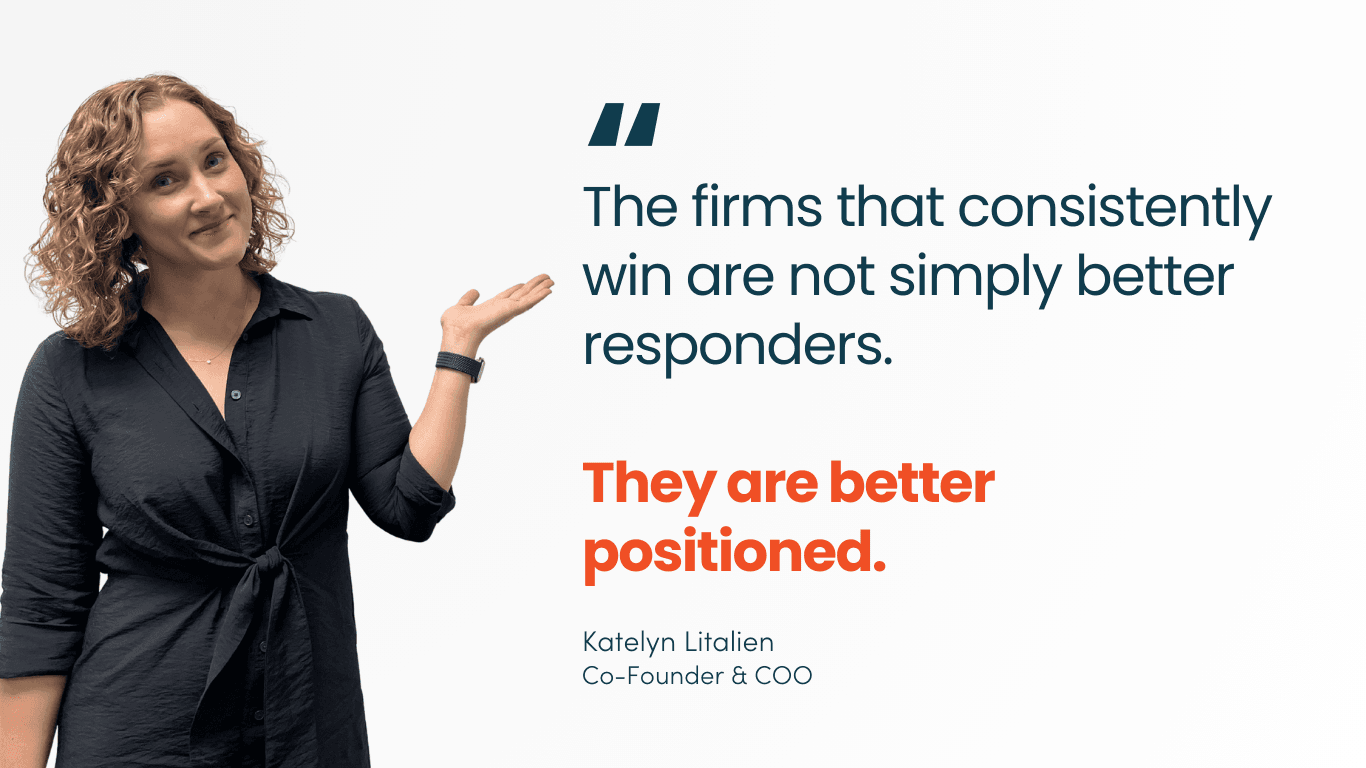
In A/E business development, the firms that consistently win are not simply better responders. They are better positioned.

If you’d like an outside perspective on how your firm shows up in the market—and where earlier influence could improve pursuit outcomes—we're offering a complimentary 30-minute consultation. In that conversation, we’ll explore how your firm is currently positioned, where opportunities may exist to influence projects earlier in their lifecycle, and how you can strengthen your approach to future pursuits.


Authored by

Katelyn Litalien

Co-Founder & COO

Join Our Mailing List

Join Our Mailing List


more stories
Stop Playing It Safe: Why A/E Firms Must Differentiate to Compete

Stop Playing It Safe: Why A/E Firms Must Differentiate to Compete

Many A/E firms lose work not because of a lack of expertise, but because they look and sound like everyone else. This article explores the hidden cost of playing it safe, what other industries do differently, and how clearer differentiation makes client decisions easier and win rates stronger.

Compete like a Giant: A Leadership Playbook for A/E Firms

Compete like a Giant: A Leadership Playbook for A/E Firms

What separates the firms that grow despite unpredictable conditions, and the ones that get stuck? Intentional action. This playbook breaks down the four pillars that help A/E firms compete like giants and the key things leaders should prioritze this year.