WHY GROWTH FEELS HARDER THAN IT SHOULD
If you lead an architecture, engineering, or design firm, you’ve likely asked yourself the question, “Why does growth feel harder than it
should?”
Your people are strong.
Your work is competitive.
And you are investing time, energy, and resources into business development.
Yet every year, it seems to take more effort to win the same amount of work. More pursuits, more persuasion, and more pressure on BD and
marketing teams just to keep pace.
This isn’t a coincidence. And it isn’t just the market.
It’s an indicator that your firm is likely operating in a permanently responsive state, and responsiveness is
expensive.
When growth relies on reacting, it will always cost more than it should.
A REACTIVE GROWTH MODEL
Most A/E firms are built to respond.
Respond to RFPs.
Respond to client demands.
Respond to market shifts, staffing needs, and competitive pressure.
In this model, growth depends heavily on short-term activation: pursuits, proposals, presentations, and relationships. These efforts are
necessary, but when they become the primary growth engine, everything happens late in the decision cycle—once an opportunity is already in
motion rather than shaping demand upstream.
By the time your firm shows up, clients are already forming preferences, fee pressure is already present, and differentiation has
to be explained instead of recognized. Business development feels harder than it should because you’re constantly trying to influence
decisions after they’ve begun.
What’s missing isn’t more activity; it’s a shared foundation that guides how you make decisions, communicate value, and show up in the
market.
In many firms, brand has been relegated to something to execute rather than treated as a strategic anchor for decision-making across the organization. Marketing and BD teams are asked to drive growth, but without a clear growth strategy, shared language, or leadership alignment, they’re left responding to requests instead of shaping direction.
The result is a reactive cycle. Marketing produces what’s needed for the next pursuit. BD adapts messaging on the fly. Teams across the firm
are left to interpret who the firm is, often with differing perspectives. Over time, this constant adaptation waters down the brand, leaving
clients and teams with an increasingly blurry understanding of what the firm actually stands for.
This is where brand becomes an executive concern rather than a marketing function. Not because marketing shouldn’t have a voice in it (they
absolutely should!), but because brand operates at the firmwide level—shaping decisions, alignment, and direction. Without that clarity,
growth remains reactive rather than proactive..

Want to understand where brand alignment is breaking down?
We’ve created a practical resource that walks you through the foundational elements of a strong A/E brand.
BRAND AS THE LONG-TERM FORCE BEHIND GROWTH
Brand is often misunderstood in the built environment industry. It’s typically seen as the logo, color palette, or fonts used in a proposal
or website. But its role is far more strategic.
Brand is the perception of who you are, what you stand for, and the unique value you provide internally (to your talent) and externally (to
your clients). A well-articulated brand is the rallying cry that makes people want to work with and for you. And when done
well, it reduces the cost of growth over time.
When brand functions as a growth lever, it does work before a pursuit begins. It shapes how your firm is perceived when you’re not in the
room. It builds familiarity and confidence ahead of need and makes growth less dependent on late-stage persuasion.
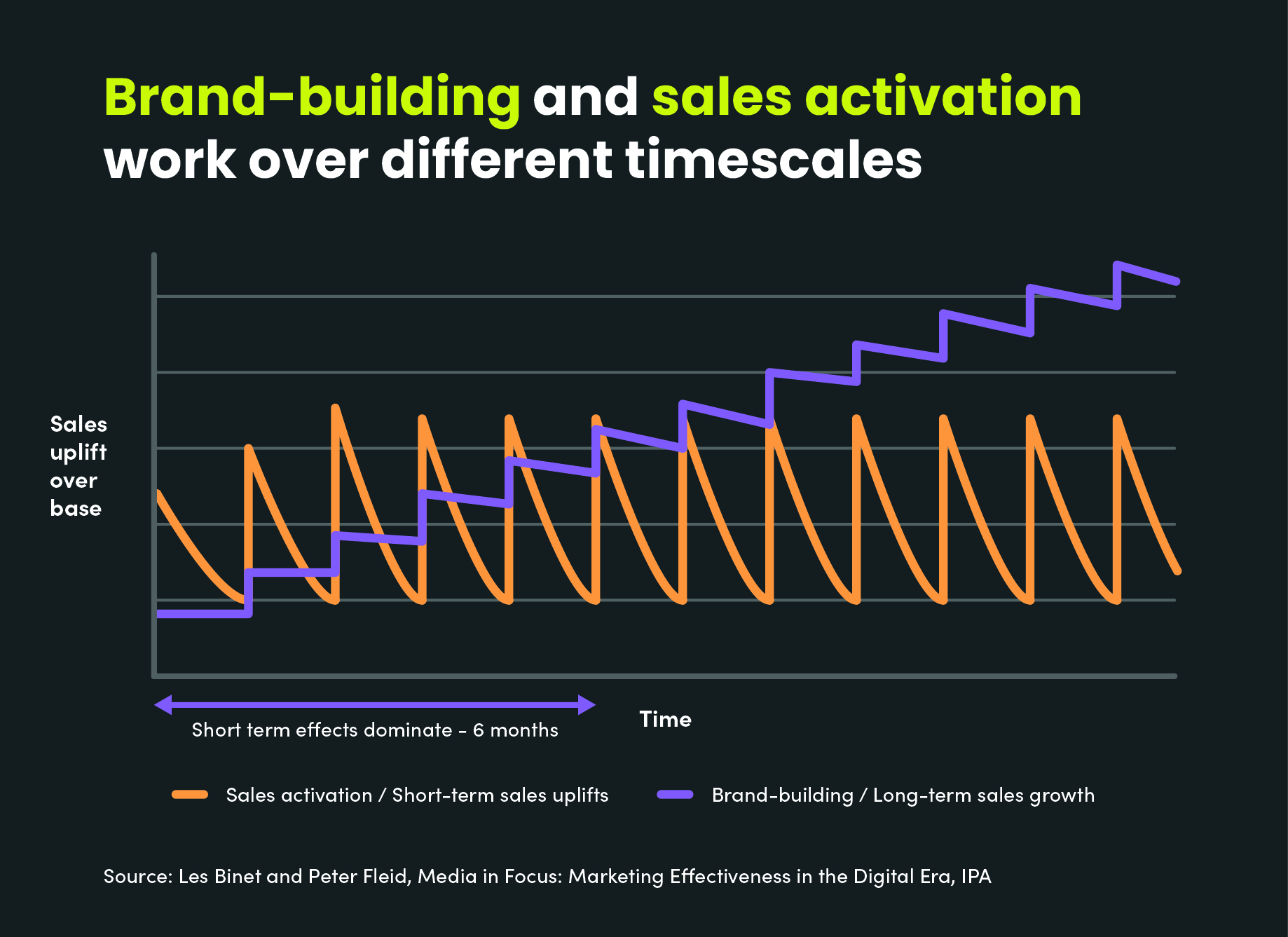
This distinction is well documented in research. In "The Long and the Short of It" and later in "Media in Focus," Les Binet and Peter Field show that brand-building and sales activation operate on different timescales. Short-term activation drives immediate spikes in response, while brand-building compounds over time — steadily increasing baseline demand, preference, and mental availability. This matters even more in industries with long sales cycles, like architecture, engineering, and construction.