The Winning Dialogue: Creating a Cohesive Brand Experience

How A/E firms align marketing, business development, and practice to drive sustainable growth

Enarche blog

The Gap between Ambition and Reality

After years of asking built environment leaders what their top priorities are, the same themes consistently emerge. They may not be in this particular order, but you're likely trying to achieve a few (if not all) of these, too.

  •        Filling the pipeline and winning more work
  •        Creating a culture that attracts and retains top talent
  •        Establishing a brand that goes beyond a single person or select individuals 
  •        Making an impact on our built world through design

While these aspirations are widely shared across the industry, achieving them in a scalable way is far less common. 

Why?

The answer is complex, of course. But one pattern I see repeatedly is this: leaders solve challenges in isolation without fully examining how the entire firm functions as a system. With the best intentions, initiatives are designed to strengthen one area—marketing, business development, project delivery—but not the whole. Over time, those well-meaning decisions create silos that quietly work against the very goals leadership is trying to achieve.

Here’s what I mean.

If you were to independently sit in on a marketing meeting, a business development strategy meeting, and a project kickoff, you might notice something surprising. Each team is circling the same underlying challenges but with entirely different languages, priorities, and definitions of success. Each conversation makes sense on its own. Taken together, they often fail to connect.

This is not just an operational issue. It’s a brand issue.

Because brand is not what your marketing or leadership team says. It’s what your clients consistently experience across every interaction. And when marketing, business development, and practice are not aligned, your brand fragments.


The Silent Friction Inside A/E Firms

In architecture and engineering firms, marketing, business development, and practice often operate as parallel tracks rather than a coordinated system. Marketing focuses on visibility and positioning. Business development builds relationships and pursues leads/opportunities. Practice delivers the work and manages clients.

Each function is working hard. But not necessarily working together or with the right priorities.

There’s a reason for this.

For much of the 20th century, marketing and business development were not simply discouraged in the built environment—they were considered beneath the profession. So much so that in 1909, the American Institute of Architects (AIA) banned architects from competing based on fees and using even the most basic forms of marketing and business development.1 Architects weren’t the only ones affected by this mentality either. In 1962, the National Society of Professional Engineers implemented a code of ethics that prohibited its members from listing their names in the newspaper and later placed extreme limitations on which marketing practices were permitted.2 Instead, the industry relied on reputation and referrals. “The work should sell itself” wasn’t just a phrase. It was a limiting operational structure.

Although those restrictions were lifted in the 1980s, the cultural imprint remained. Practice became the sacred center. Marketing was positioned as support (task takers). Business development was tolerated, sometimes embraced, but rarely integrated into firm leadership strategy.

Progress has been made. But integration? That’s a different story.

Today, many A/E firms still operate in silos that create invisible friction across the client experience.
Creating the “Winning Dialogue”

If silos create friction and fragmentation, the leadership challenge is not simply to improve individual departments. It is to close the gaps that form between them.

An integrity gap emerges when a firm’s stated positioning, its business development conversations, and its project delivery do not fully reinforce one another. Marketing develops language to articulate value. Business development adapts that message in pursuit settings. Practice delivers under real-world constraints. When these three expressions of the firm are not aligned, the brand becomes inconsistent—not because anyone intended it to be, but because no one designed it to be cohesive. And inevitably, this erodes brand credibility and leads to growth that relies on individual “superstars” rather than systemic alignment.

Closing that gap requires more than better messaging or stronger pursuit activity. It requires an intentional dialogue across marketing, business development, and practice.

At Enarche, we refer to this as the “Winning Dialogue”.


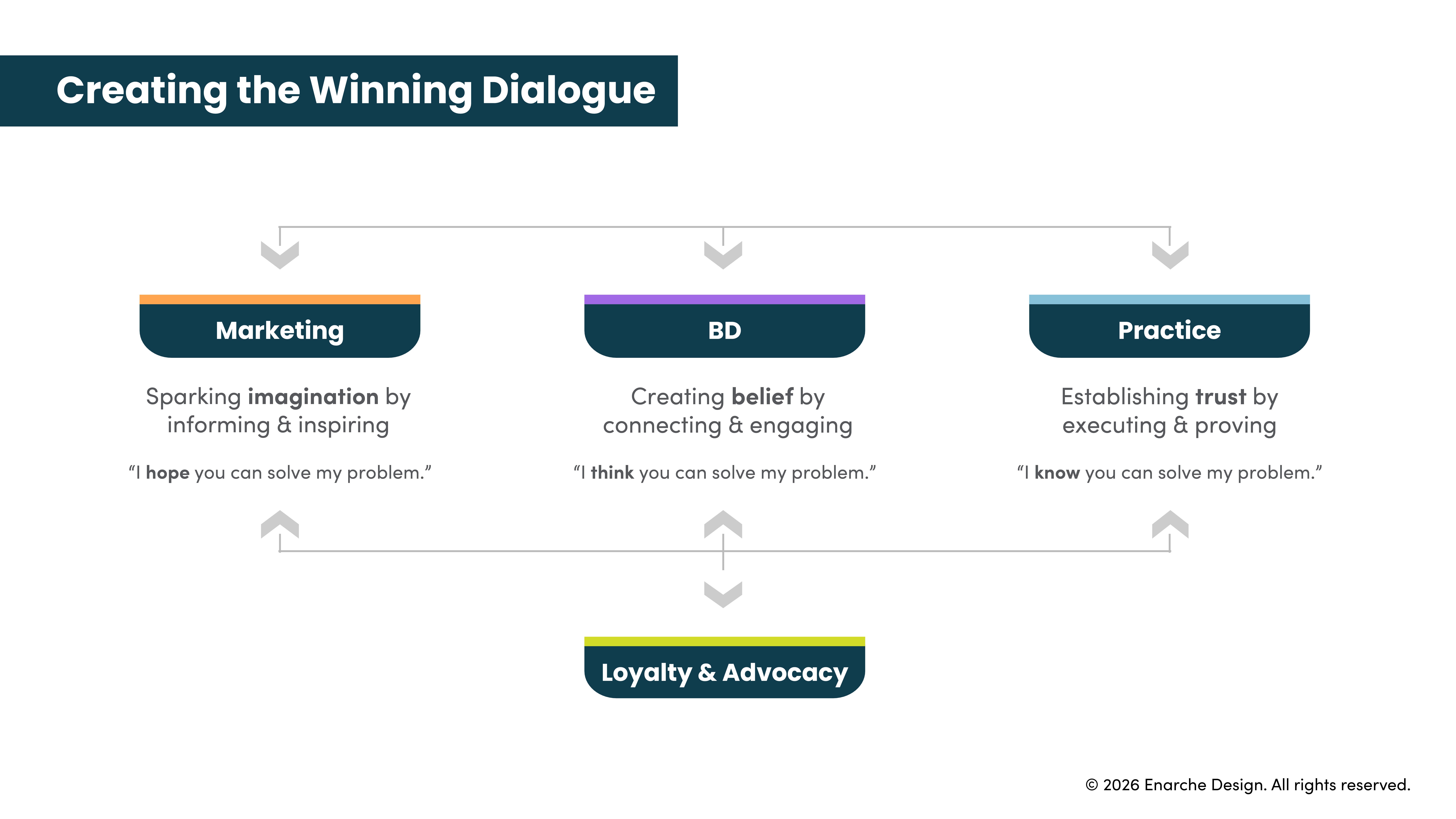
The Winning Dialogue is not a meeting cadence or a reporting structure. It is a leadership discipline. It ensures that each function informs the other. Marketing clarifies and broadcasts the firm’s value in the marketplace, business development pressure-tests and translates that value in real client conversations, and practice operationalizes and proves it through delivery. As information is shared, improvements are made accordingly. The brand promise is not simply communicated—it is reinforced with every touchpoint a current or potential client has with your firm.

When that dialogue exists, growth becomes more predictable because the firm presents itself coherently. Marketing sparks imagination. Business development builds belief. Practice establishes trust. The brand becomes an experience, not just a statement. It aligns narratives, decisions, behaviors, and expectations around a shared brand promise—ultimately creating loyalty and advocacy.


And the impact is measurable. Research consistently shows that highly aligned firms grow faster and are more profitable than their misaligned counterparts—by as much as 19% in revenue growth and 15% in profitability.3 Alignment is not just a cultural ideal; it is a strategic advantage.  

BOLD TITLE

Placeholder Text for freebie (if we do it)
Button here.


The Leadership Imperative

The aspirations we began with are not unique to your firm. They echo across the built environment industry—growth that lasts, reputation that extends beyond individuals, and work that genuinely matters.

The question is not whether those goals are valid. They are. The question is whether your firm is structured to support them.

Because pipeline strength, talent retention, brand equity, and client service are not separate initiatives. They are outcomes of alignment. They are the byproduct of how well marketing, business development, and practice operate in dialogue. 

The Winning Dialogue is not about adding complexity to your organization. It is about reducing friction within it. It is about ensuring that what your firm says, sells, and delivers reflects the same promise.

If you suspect there are gaps between how your firm positions itself and how it is experienced in the market, it may not be a marketing issue. It may not be a business development issue.

It may be an alignment issue.


At Enarche, we work with architecture and engineering firm leaders to assess where integrity gaps exist and design operating models that bring marketing, business development, and practice into strategic alignment—so brand becomes operational, and growth becomes scalable.

If you’re ready to examine how your firm’s internal dialogue shapes its external reputation, let’s connect.

Book a 30-min consultation Book a 30-min consultation


References:

1 Jane Kolleeny and Charles Linn, AIA, “Marketing: Lessons from America’s best-managed architectural firms” Architectural Record (2002), https://www.architecturalrecord.com/ext/resources/archives/practice/pdfs/02marketing.pdf
Scott Butcher, “A Brief History of Professional Services Marketing” Aecumen, https://aecumen.com/2019/04/24/a-brief-history-of-professional-services-marketing/
Phill Harrell, “Perspective on Alignment: Outdated Stereotypes, Pipeline and Revenue Goals for Marketing” Forrester (2020), https://www.forrester.com/blogs/sales-executive-perspective-on-alignment/

Authored by

Dez Joslin

Founder & CEO

Join Our Newsletter!

Join Our Mailing List


more stories
Stop Playing It Safe: Why A/E Firms Must Differentiate to Compete

Stop Playing It Safe: Why A/E Firms Must Differentiate to Compete

Many A/E firms lose work not because of a lack of expertise, but because they look and sound like everyone else. This article explores the hidden cost of playing it safe, what other industries do differently, and how clearer differentiation makes client decisions easier and win rates stronger.

Compete like a Giant: A Leadership Playbook for A/E Firms

Compete like a Giant: A Leadership Playbook for A/E Firms

What separates the firms that grow despite unpredictable conditions, and the ones that get stuck? Intentional action. This playbook breaks down the four pillars that help A/E firms compete like giants and the key things leaders should prioritze this year.

Small Moves, Big Momentum.

Small Moves, Big Momentum.

In the AEC industry, sustainable growth isn’t driven by big moves alone — it’s shaped by clarity, leadership, and consistent strategic action. This year-end reflection explores how small, intentional decisions create lasting momentum for firms navigating shifting market demands. Discover the three leadership disciplines every firm needs heading into the new year.

The Hidden Drivers Behind Why Clients Choose You

The Hidden Drivers Behind Why Clients Choose You

Most A/E firms focus on what they did instead of why it mattered. This article explores how understanding and communicating the true value of your work—increasing revenue, decreasing cost, and mitigating risk—can transform your storytelling, strengthen client connections, and position your firm as a trusted advisor rather than a service provider.

Beyond the Portfolio: How Gensler's Website Signals a Shift in A/E Marketing

Beyond the Portfolio: How Gensler's Website Signals a Shift in A/E Marketing

Your website should be more than a gallery. Explore how top A/E firms are turning their sites into strategic business development tools that clarify value and convert opportunities.

Smarter A/E Business Development Starts with the Right Tech Stack

Smarter A/E Business Development Starts with the Right Tech Stack

Discover the best BD tech tools for architecture & engineering firms. Streamline workflows, win more work, and download our free comparison guide.

The Hidden Inefficiencies Holding Your A/E Firm Back

The Hidden Inefficiencies Holding Your A/E Firm Back

Struggling to improve your A/E firm's marketing and BD performance? Learn the 5 most common inefficiencies holding your firm back – and how to fix them to increase visibility, streamline operations, and win better work.

The 3 Mistakes Your Firm is Making...

The 3 Mistakes Your Firm is Making...

Too often, A/E firms waste time searching for vital information, fail to verify if that information is accurate, or worse, operate within isolated ecosystems, redundantly storing data. These threats to your success are the direct result of three common mistakes...

Designing with Purpose

Designing with Purpose

In the evolving world of architecture and design, the ability to challenge conventions and drive innovation with a clear purpose is essential—and frankly, slow in comparison to other markets. Leslie Chiu, with her extensive background in design and her tenure at WeWork, exemplifies how visionary leadership can reshape the landscape of workplace design. 

What A/E Firms Should Learn From Stanley

What A/E Firms Should Learn From Stanley

Stanley was a brand best associated with gruff construction workers or professionals looking to keep their coffee warm during a busy commute to work. So how is it that this same company is now associated with TikTok, influencer culture, and fashion? Keep reading to find out!

Southern A/E Boom? Capitalizing on the Financial Firm Exodus

Southern A/E Boom? Capitalizing on the Financial Firm Exodus

In a shift that has reshaped the business landscape, the migration of financial firms from Northeast and West Coast capitals has created a rift in the financial industry's geographic footprint.

How Shelli Decker is Shaping A/E Marketing through Storytelling

How Shelli Decker is Shaping A/E Marketing through Storytelling

In the world of architecture and engineering (A/E), where innovation meets precision, marketing often finds itself at a crossroads.

The Future of A/E Marketing

The Future of A/E Marketing

Your designs transform culture, revitalize neighborhoods, and create environments where people can thrive, but does your marketing match this impact?