The Gap between Ambition and Reality
After years of asking built environment leaders what their top priorities are, the same themes consistently emerge. They may not be in this particular order, but you're likely trying to achieve a few (if not all) of these, too.
- Filling the pipeline and winning more work
- Creating a culture that attracts and retains top talent
- Establishing a brand that goes beyond a single person or select individuals
- Making an impact on our built world through design
While these aspirations are widely shared across the industry, achieving them in a scalable way is far less common.
Why?
The answer is complex, of course. But one pattern I see repeatedly is this: leaders solve challenges in isolation without fully examining
how the entire firm functions as a system. With the best intentions, initiatives are designed to strengthen one area—marketing, business
development, project delivery—but not the whole. Over time, those well-meaning decisions create silos that quietly work against the very
goals leadership is trying to achieve.
Here’s what I mean.
If you were to independently sit in on a marketing meeting, a business development strategy meeting, and a project kickoff, you might notice
something surprising. Each team is circling the same underlying challenges but with entirely different languages, priorities, and
definitions of success. Each conversation makes sense on its own. Taken together, they often fail to connect.
This is not just an operational issue. It’s a brand issue.
Because brand is not what your marketing or leadership team says. It’s what your clients consistently experience across every interaction. And when marketing, business development, and practice are not aligned, your brand fragments.
The Silent Friction Inside A/E Firms
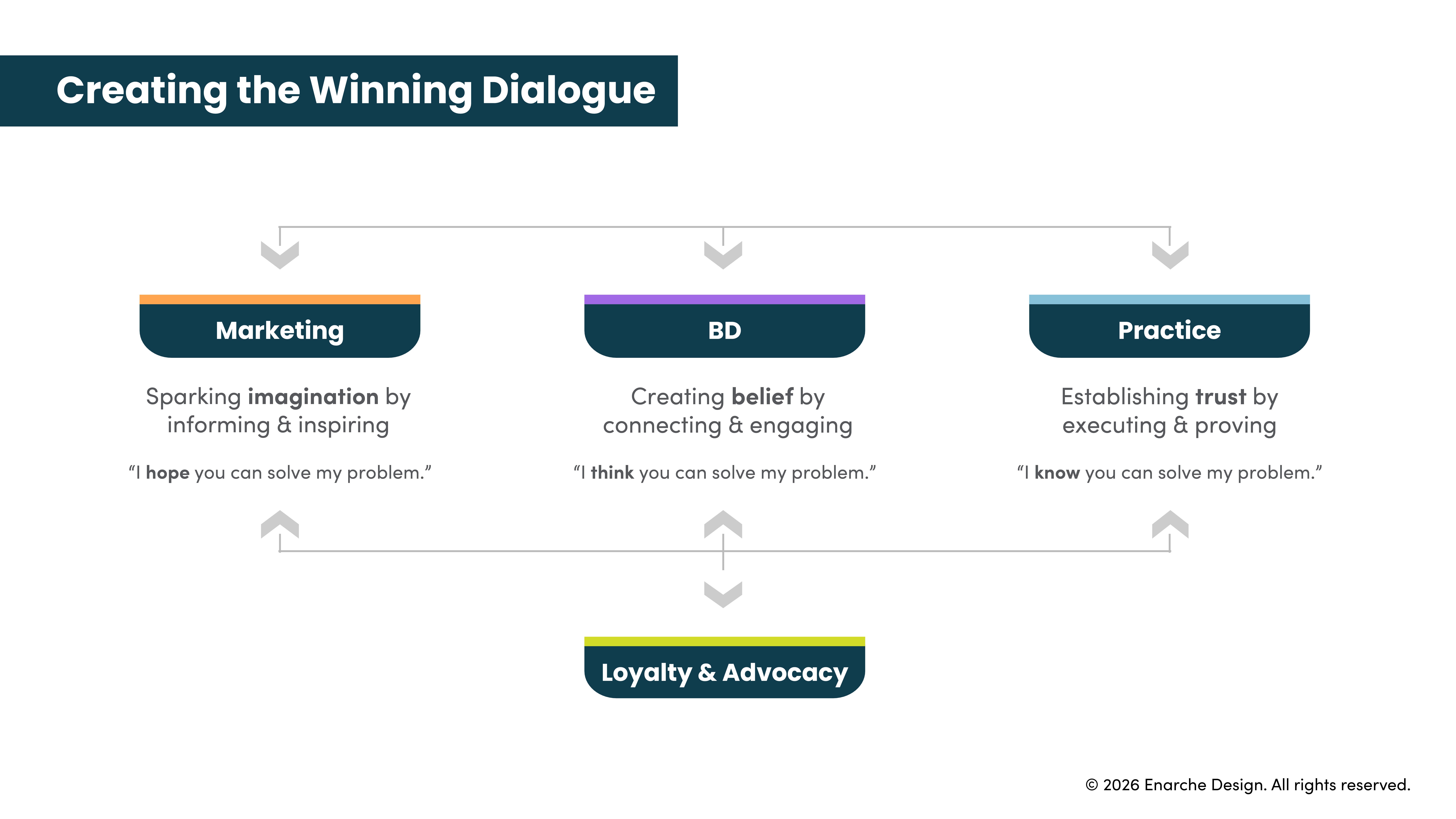
In architecture and engineering firms, marketing, business development, and practice often operate as parallel tracks rather than a
coordinated system. Marketing focuses on visibility and positioning. Business development builds relationships and pursues
leads/opportunities. Practice delivers the work and manages clients.
Each function is working hard. But not necessarily working together or with the right priorities.
There’s a reason for this.
For much of the 20th century, marketing and business development were not simply discouraged in the built environment—they
were considered beneath the profession. So much so that in 1909, the American Institute of Architects (AIA) banned architects from competing
based on fees and using even the most basic forms of marketing and business development.1 Architects weren’t the only ones
affected by this mentality either. In 1962, the National Society of Professional Engineers implemented a code of ethics that
prohibited its members from listing their names in the newspaper and later placed extreme limitations on which marketing
practices were permitted.2 Instead, the industry relied on reputation and referrals. “The work should sell itself” wasn’t just a
phrase. It was a limiting operational structure.
Although those restrictions were lifted in the 1980s, the cultural imprint remained. Practice became the sacred center. Marketing was
positioned as support (task takers). Business development was tolerated, sometimes embraced, but rarely integrated into firm leadership
strategy.
Progress has been made. But integration? That’s a different story.
Today, many A/E firms still operate in silos that create invisible friction across the client experience.